


The quick answer
- 01The idea: the partner often matters as much as the software, so interview them as carefully as you would a senior hire.
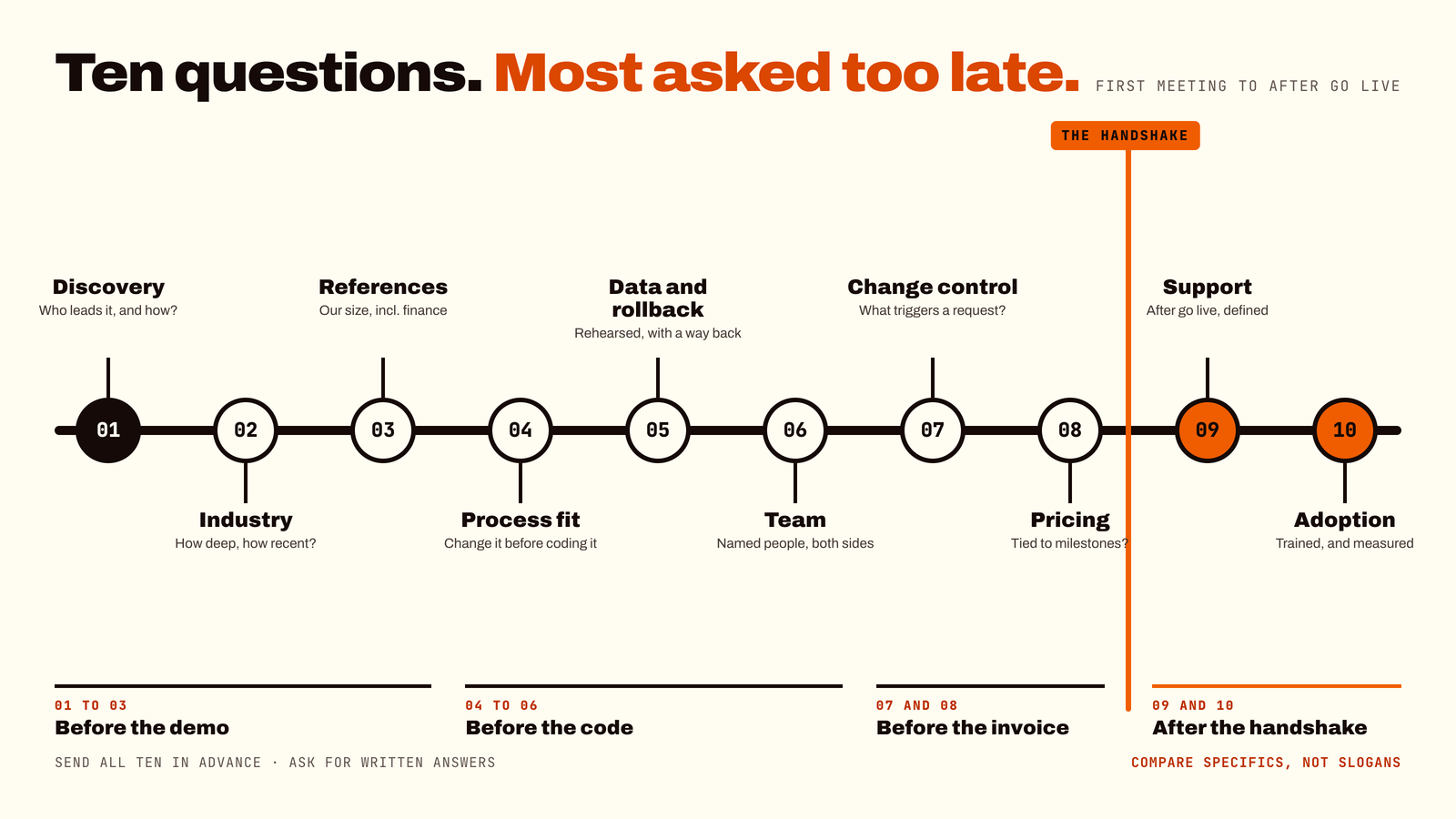
- 02The ten questions: discovery, industry, references, fit vs code, data and rollback, team, change control, pricing, support, adoption.
- 03Biggest green flag: they ask about your processes before showing you a demo.
- 04Biggest red flag: support that quietly ends on go-live day.
Choosing a partner is like choosing a surgeon, only with fewer gowns
Business Central is a capable product. But the same software can lead to a smooth go-live in one business and a long, expensive headache in another, and the difference is usually the partner. They shape your design, move your data, train your people and answer the phone when month-end goes strange.
The trouble is that every partner sounds great in a sales meeting. Everyone has a polished demo and a friendly smile. These ten questions help you get past the polish. They work for any business size, in any industry, and you can use them with us too. In fact, please do.
1. What does your discovery process look like, and who leads it?
Why it matters. Discovery is where your needs are turned into a plan. If it is run by sales staff, details get lost. If it is run by experienced consultants, you get a plan you can trust.
What good sounds like. A clear, structured discovery led by named consultants, with workshops on your real processes and a written summary you review.
2. How deeply, and how recently, have you worked in our industry?
Why it matters. Knowing the software is not the same as knowing your workflows. A partner who has never seen your kind of business may configure Business Central to standard workflows instead of your operations.
What good sounds like. Specific examples from your sector, and a willingness to say where they are less experienced.
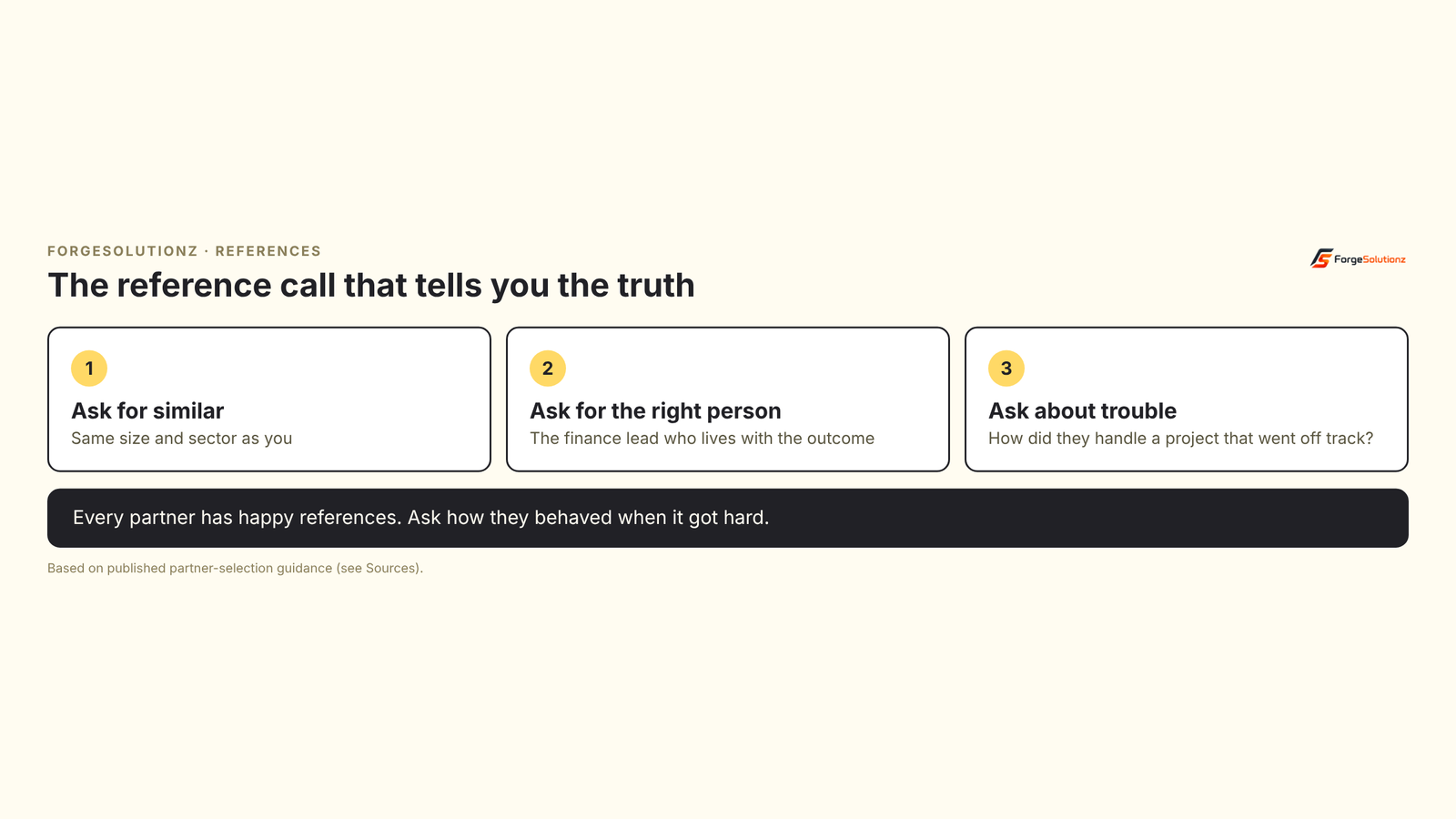
3. Can we speak to references of similar size and sector, including their finance lead?
Why it matters. A reference from a similar company tells you more than a famous logo. The finance lead is the person who lives with the outcome every month.
What good sounds like. Two or three comparable references, offered without fuss. Ask one of them how the partner behaved when something went wrong.
4. What do you do when our process doesn't match standard Business Central?
Why it matters. This shows whether they challenge your processes before writing code. Heavy customization raises cost and makes upgrades harder.
What good sounds like. "We look at whether the process should change first, and customize only where there is a real business reason."
5. What is your data migration method, and what is the rollback plan?
Why it matters. Data migration is a classic source of overruns, and go-live day is not the time to discover there is no way back.
What good sounds like. A phased method with checkpoints, rehearsal loads, reconciliation of key balances and a tested fallback plan.
6. Who exactly will be on our project, and who does what on both sides?
Why it matters. Projects stall when nobody knows who decides. A clear roles model shows the partner has done this before.
What good sounds like. Named people, their roles, and what they need from you, written down.
7. How do you handle changes after the scope is signed, and what triggers a change request?
Why it matters. Every project discovers things along the way. What matters is whether changes are handled fairly and transparently.
What good sounds like. A defined change process, with estimates before work starts and no surprises on the invoice.
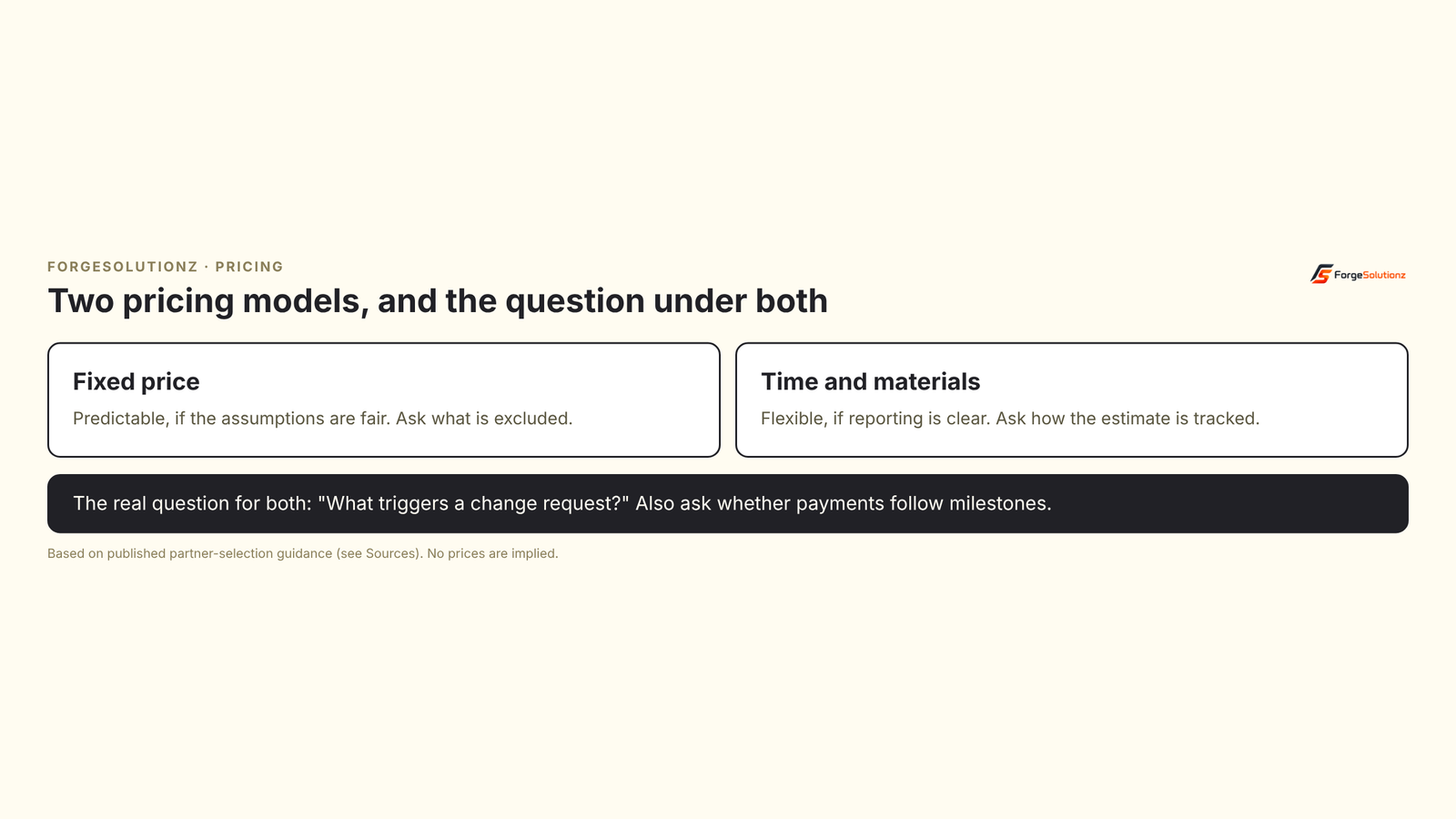
8. Is your pricing fixed or time and materials, and are payments tied to milestones?
Why it matters. Both models can work. Fixed price gives predictability if the assumptions are fair. Time and materials gives flexibility if reporting is clear.
What good sounds like. A plain explanation of what is included and excluded, and payments that follow delivery, not just dates.
9. What does your support include after go-live, and how long is the intensive period?
Why it matters. Some partners treat go-live as the end of the engagement, leaving you to adapt alone. The first weeks are when questions are most frequent.
What good sounds like. A defined hypercare period, response times by severity, and ongoing support as your business changes.
10. How do you support adoption, and how do you measure it?
Why it matters. A system people avoid is not a success, however technically perfect. Training and change management decide whether the investment pays off.
What good sounds like. Role-based training, early communication plans and a way to check how people are actually using the system after go-live.
Bonus checks worth five minutes
- 01Microsoft credentials. Look for the Business Applications designation and any industry specializations. Ask what they mean for your project.
- 02Add-on knowledge. Ask which third-party apps they have implemented alongside Business Central. It shows how well they understand what clients end up needing.
- 03A sample statement of work. It shows how specific and honest their scoping is.
- 04A project that went off track. Ask for an example, and what happened next.
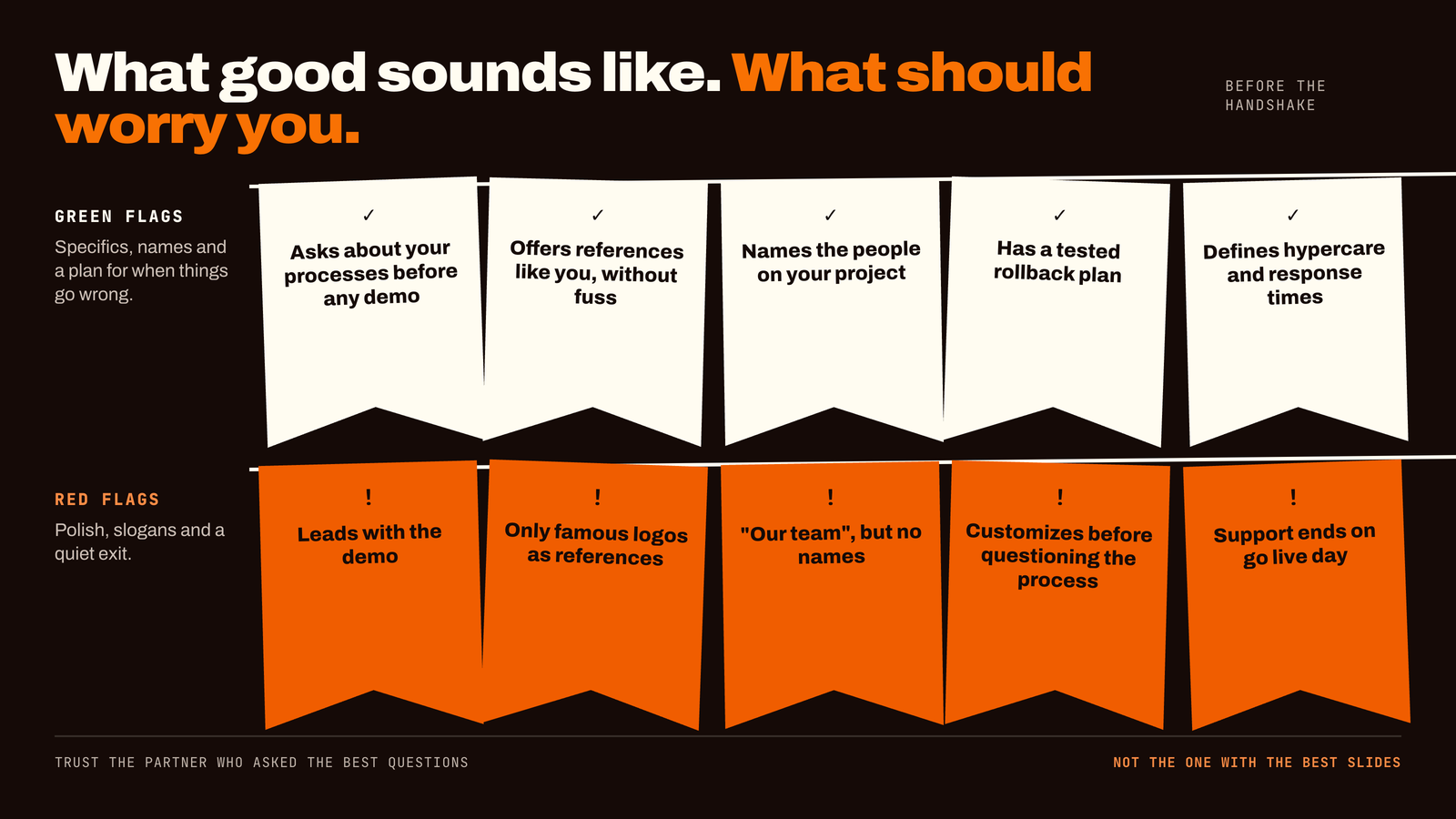
Green flags and red flags
How to run the conversation
- 01Step 1. Send your shortlist the ten questions in advance, and ask for written answers.
- 02Step 2. Compare answers side by side. Look for specifics, not slogans.
- 03Step 3. Call the references, including the finance lead.
- 04Step 4. Ask each finalist for a sample scope and a pricing outline for the same requirements, so you can compare like with like.
- 05Step 5. Trust the partner who asked you the best questions, not the one with the best slides.
Frequently asked questions
- 01How many partners should we talk to? Two or three is usually enough. More than that and the comparison gets harder rather than better.
- 02Is the cheapest quote the best choice? Not by default. Compare what is included, what triggers extra charges and what support covers, then judge the total picture.
- 03Do we need a partner in our own country? Not always, but local knowledge of regulations and time zones can matter. Ask how they handle both.
- 04Should the partner know our industry? It helps a lot. Industry familiarity means fewer surprises and less time explaining basics.
- 05What if we already chose a partner? Use the questions anyway to check your plan, especially the ones on change control, data rollback and support.
- 06Can we ask ForgeSolutionz these questions? Please do. We would rather be chosen on clear answers than on a good demo.
Two-minute partner scorecard
After each partner conversation, tick what is true:
- 01They asked about our processes before showing a demo.
- 02They gave references of similar size and sector.
- 03They named the people who will work on our project.
- 04They explained how data migration and rollback work.
- 05They were clear on what triggers extra cost.
- 06They described support after go-live in specifics.
Five or six ticks is a strong partner. Fewer than four is worth another conversation before you sign.
Key takeaways
- 01The partner shapes the outcome as much as the software.
- 02Ask for specifics: discovery, industry, references and named people.
- 03Test how they handle process fit, data rollback and change requests.
- 04Compare pricing models by what is included and what triggers extra cost.
- 05Make sure support continues after go-live.
Want to put us through the ten questions?
At ForgeSolutionz, our Business Central specialists will answer them openly, with examples. We'll walk through our discovery and delivery approach, share references and a sample scope on request, and explain our pricing model and what triggers change requests. No obligation — you'll leave with a clear next step, even if you never work with us.
Book a consultation